
Mental fog is usually a mix of three things: scattered attention, a noisy stress response, and too many open loops in your head. The good news is you don’t need an hour-long routine to clear it. The right five-minute reset can sharpen your focus, slow the mental spin, and help you decide what to do next.
Below are seven mental clarity exercises you can do anywhere: at your desk, between classes, before a call, or when you’re stuck doom-scrolling. Each one includes a simple mini routine you can repeat daily.
Why These Mental Clarity Exercises Work When You Only Have 5 Minutes
Most people try to “think harder” when they feel foggy. That usually backfires because mental clarity isn’t just about effort. It’s about directing attention and reducing competing signals (stress, rumination, distraction).
Here’s what the best mental clarity exercises do in a short window:
- They narrow your focus to a single anchor (breath, body sensation, or a single task).
- They interrupt stress physiology, which can make your thoughts feel loud and jumpy.
- They create a quick sense of control by giving your brain one clear next step.
Research supports this general idea: even brief mindfulness-style practices can improve attention and executive control in people new to them.
Breathing-based practices also show benefits for stress and mental health across many studies. However, results vary by method and population. Short bouts of physical activity can improve aspects of executive function, such as working memory and inhibitory control, in some contexts.
Think of the next seven techniques as “attention steering wheels.” You’re not trying to fix your whole life in five minutes. You’re just trying to reset your state so thinking becomes easier.
What are the Best Mental Clarity Exercises You Can Do in 5 Minutes?
1. Box breathing
When your brain is racing, your breathing is usually shallow and fast. Box breathing flips that pattern and gives your mind something structured to follow. It’s simple, and it’s popular for a reason: it forces your attention into a predictable rhythm.
These practices can improve overall stress and mental health outcomes. There’s also clinical research on box breathing, particularly in specific patient groups, demonstrating its stress-reducing.
5-minute mini routine
- Sit upright. Unclench your jaw. Drop your shoulders.
- Inhale through your nose for 4.
- Hold for 4.
- Exhale slowly for 4.
- Hold for 4.
- Repeat for about 5 minutes.
2. The 5-4-3-2-1 Sensory Scan
Mental fog often comes from being mentally “somewhere else.” This exercise uses your senses to refocus your attention on what’s real and immediate. It’s grounding without being cheesy.
5-minute mini routine:
Go through the list slowly. Say it quietly or in your head.
- 5 things you can see (colors, shapes, light, small details)
- 4 things you can feel (feet in shoes, fabric texture, air on skin)
- 3 things you can hear (near sounds, far sounds, silence)
- 2 things you can smell (even subtle smells count)
- 1 thing you can taste (sip water, gum, or notice your mouth)
If your brain keeps interrupting:
That’s normal. Each time you return to the senses, you’re doing the rep. These kinds of attention reps are why mental clarity exercises can work even when your mood doesn’t cooperate.
3. One-minute Mindfulness + Four-minute Task
If you want clarity, you usually want it for a reason: you need to do something. This exercise pairs a short attention reset with a micro sprint so your clarity turns into action.
Brief mindfulness practice has been shown to improve aspects of attentional control even after a single short session in some studies.
5-minute mini routine:
Minute 1: Attention reset
- Close your eyes (or soften your gaze).
- Focus on your breath at your nostrils or at your chest.
- When you notice thinking, label it once: “thinking.”
- Return to the breath.
Minutes 2–5: Task lock
Pick one tiny, concrete action you can finish in four minutes:
- Rename and file 5 documents.
- Outline 3 bullet points for a paragraph.
- Reply to one email.
- Read one page and summarize it in 2 lines.
Rules that make this actually work
- No switching tasks.
- No research rabbit holes.
- If you finish early, stop. Ending clean trains your brain to trust the routine.
This is one of my favorite mental clarity exercises because it converts “I feel foggy” into “I did something.”
4. Brain Dump to Next Step
Mental clutter is often unfinished business. Your brain keeps reloading the same tabs because it’s scared you’ll forget them. A quick external brain dump reduces that pressure.
Expressive writing and short writing interventions have a solid research history of helping people process stress and emotions, with effects that vary by person and context. You’re not writing a novel here. You’re unloading mental noise.
5-minute mini routine
Set a timer. Use paper or a notes app.
Minutes 1–3: Dump
Write fast. No grammar. No structure.
- “I have to…”
- “I’m worried about…”
- “I keep thinking about…”
- “I should…”
Minutes 4–5: Convert
Circle one item and write:
- Next step (tiny): the very first action
- Time needed: 2 min / 10 min / 30 min
- When: today at a specific time
Example
- Dump: “I’m behind on the project.”
- Convert: “Open doc, write 3 bullets for section 1, 10 minutes, 3:30 PM.”
5. Five-minute Movement Reset
Sometimes, fog is just low energy and a stale posture. A short, moderate movement burst can shift your state fast. Research suggests a single relatively short bout of exercise can improve working memory and inhibitory control in some settings.
5-minute mini routine (no equipment)
Choose one track:
Track A: Calm + steady
- 60 seconds: brisk walk (hallway, outside, stairs)
- 60 seconds: shoulder rolls + neck turns
- 60 seconds: bodyweight squats (slow, controlled)
- 60 seconds: march in place + big arm swings
- 60 seconds: slow breathing to settle
Track B: Quick wake-up
- 30 seconds: jumping jacks (or step jacks)
- 30 seconds: rest
- Repeat 5 rounds
Important
You don’t need to go hard. The point is to change your physiology enough that your attention stops dragging.
For many people, this becomes the most reliable of all mental clarity exercises because it doesn’t require “being in the mood.”
6. 5-minute Clarity Check-in
If you want an exercise you’ll actually repeat, reduce friction. This is where Mindsaurus fits naturally: it’s a wellness app and digital platform built to help users, especially teens and young adults, cultivate a more positive mindset, practice gratitude, and manage negative thoughts.
When you’re foggy, stressed, or emotionally flat, the hardest part is not knowing where to start. A guided check-in removes that decision fatigue. Instead of trying to “fix your mood,” you’re simply creating a clearer internal snapshot, then nudging your brain toward one slightly better direction for the next hour.
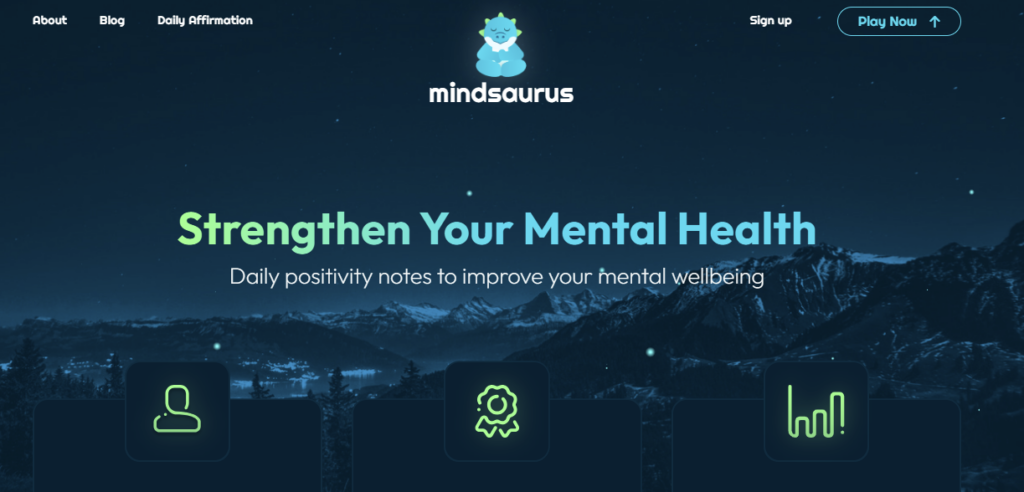
Here’s how you can do it:
- Name it + rate it: Label your state (foggy, stressed, distracted) and rate it 1–10.
- 3 micro-gratitudes: Write three specific, believable things you appreciate (tiny counts).
- Spot the loud thought: Write the main negative thought that keeps repeating.
- Reframe for the next hour: Replace it with a more useful thought you can test immediately.
- Choose one next action: Pick a 2-minute step you can do right after the check-in.
7. Anti-Multitasking Drill
Much of the mental fog isn’t mysterious. It’s the result of constant context switching. Notifications, open tabs, background noise, and half-finished thoughts compete for attention. Your brain doesn’t get the chance to settle into one lane long enough to think clearly. The single-task spotlight is designed to retrain that ability in a controlled, five-minute window.
This exercise works because clarity often follows sustained attention. When you deliberately focus on a single object or task, you reduce cognitive load. You’re no longer juggling. You’re narrowing.
Use this quick checklist to guide the five-minute drill:
- Pick one target: A physical object or one small work task.
- Set a timer for five minutes: No extensions.
- Remove obvious distractions: Silence notifications and close extra tabs.
- Stay with the target: Notice details or repeat one micro-action.
- When distracted, return: No judgment. Just refocus.
Wrapping Up
You don’t need seven new habits. Pick one exercise you can repeat daily for a week.
If you like structure and prompts, use Mindsaurus for your five-minute check-in. If you’re overstimulated, do the sensory scan. If you’re stuck in thought loops, do box breathing. If you’re overwhelmed, brain dump to the next step. If you’re sluggish, take a five-minute walk.
Small resets compound. And the moment you realize you can change your mental state in five minutes, you stop waiting for clarity to show up magically.